
Swimming Pools
Time-Proven Heat Exchanger Designs for All Pool Industry Heating Applications
 This century, the swimming pool industry has trended away from direct-fired heaters in favour of indirect heating systems for both residential and commercial pool water heating applications. Traditional pool heaters are self-contained appliances where a heat exchanger is housed in-unit together with a gas or electric burner/heating element; when either major component fails or the heating conditions change the whole heater must be repaired, adjusted, or replaced. In contrast, indirect heating systems separate heat sources from the external heat exchanger, allowing the system to act modularly — the heat exchanger can be upgraded or repaired independently of the rest of the heating system.
Valutech’s range of pool and spa heat exchangers contains models compatible with traditional heat sources such as boilers, heat pumps, and district heating loops as well as renewable sources such solar and geothermal systems. A well-designed residence or commercial facility can take advantage of this modular approach by using a single boiler for year-round operation, heating a pool during the summer while supplying domestic hot water, hydronic radiant heating, and snow-melt systems during the winter.
High-Efficiency Pool Heat Exchangers
The efficiencies of indirect pool heating offer highly-effective heat transfer with extended equipment life and simpler maintenance.
Indirect Pool Heat Exchangers
Indirect pool heating systems take advantage of the high operating efficiency of modern boiler systems that commonly achieve efficiencies above 80%, and in many cases, above 90%. In these installations, the boiler supplies hot water to a separate pool heat exchanger, typically in the 140-180°F temperature range.
This lower, controlled water temperature reduces the rate electrochemical corrosion occurs on heat transfer surfaces with exposure to chlorinated or saltwater pool water. Further, direct-fired pool heaters expose their internal heat exchangers to the much higher temperatures generated by a natural gas or propane flame, which both accelerates chemical reactions and increases wear on the exchanger surfaces from elevated temperature exposure.
As a result, indirect heating systems often provide not only high thermal efficiency, but also reduced component stress, lower maintenance requirements, and longer service life for the pool heat exchanger.
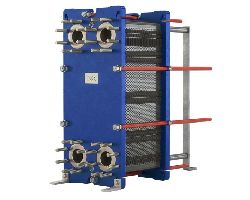
Valutech offers three heat exchanger product lines suited to indirect pool and spa heating applications. Alfa Laval gasketed plate and frame pool heat exchangers are ideal for systems with close temperature approaches using low temperature heat sources such as condensing boilers and heat pump installations. Our other plate-based model, the fusion-bonded AlfaNova, is engineered for chlorinated and saltwater pools in systems where compact size, low maintenance, and high corrosion resistance are important. CN-Series shell and tube pool heat exchangers are the preferred choice for general residential, commercial, and institutional pools of all sizes, particularly where titanium construction is required for saltwater service with robust long-term operation with maintainability as a priority.
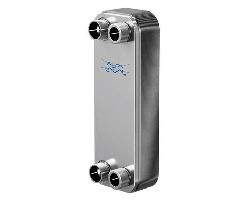
Alfa Laval’s AlfaNova units are made of 100% stainless steel, making them ideal for chlorinated pool, hot tub, and spa systems. They are also suited for make-up water heat recovery, low temperature condensing boiler, and geothermal applications.
Available Models:
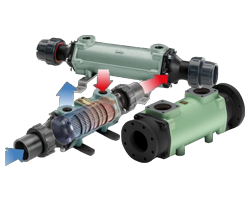
Valutech carries a wide portfolio of CN-Series shell and tube heat exchangers manufactured by EJ Bowman in England, with tube material options in titanium, SS 316, and cupronickel for use with boilers, as well as heat pumps or renewable sources.
Available Models:
For further information on a specific product line, please click on the respective product image or model number.
 Alternative heating sources, including solar and geothermal technologies, have become increasingly popular for pool water heating applications as residential and commercial buildings increasingly integrate renewable energy systems into their heating loops. As the adoption of renewable energy continues to grow, specialized heat exchangers are crucial for efficiently harnessing available thermal energy. Selecting the appropriate heat exchanger for pool heating based on the specific advantages and limitations of each renewable source is crucial to maximizing system performance.