
In the pool water heating industry, external heat exchangers are used to heat or cool residential and commercial swimming pools, therapy pools, hot tubs, spas, cold plunge pools, open-air baths, wave pools and lazy rivers, fountains, infinity pools, reflecting pools, and fish ponds, among many others. Selecting an appropriate pool heat exchanger is dependent on the application, water chemistry, and facility operating conditions. With design factors such as average flow rates and pool size.
The pool heat exchanger selection process must be performed carefully
This article provides a brief outline of factors such as water composition, flow rates, and available heat sources influence the selection of pool heat exchangers
Pool Water Chemistry
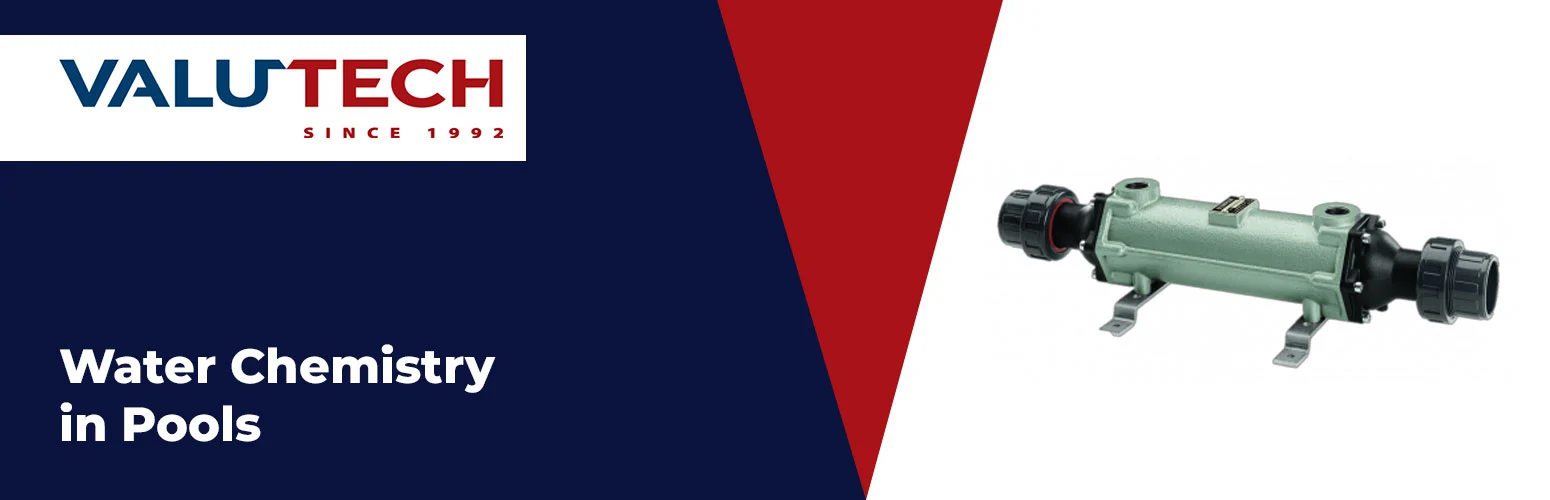
Material selection is a core factor in choosing appropriate pool heat exchanger models – Conventional chlorination, salt chlorination, and other chemical treatments as well as water temperatures.
The primary chemical concern for metallic heat transfer surfaces is the presence of chloride ions (Cl⁻), naturally present in saltwater or introduced through pool treatment chemicals. Chlorides penetrate the metallic heat transfer surfaces to create localized corrosion sites through pitting and crevicing, varying in severity based on pH, temperature, and other operating conditions. Higher temperatures generally accelerate corrosion, and promote the precipitation of mineral deposits on heat transfer surfaces
Titanium is typically selected for its exceptional corrosion resistance, particularly in saltwater pools and other systems with elevated chloride exposure. Stainless steel provides acceptable corrosion resistance for many conventional chlorinated pool applications, and SS316 is a standard grade acting as an economical variant where water chemistry is well controlled. Cupronickel is chosen as the heat transfer surface material when good corrosion resistance in saltwater is needed at a lower cost than titanium, while providing higher thermal conductivity than stainless steel; this positions it as a mid-range material that can reduce the size of the unit while providing superior corrosion resistance in more difficult applications.
Operating Conditions and Sizing
Heat exchanger sizing is a function of the required pool heating load, with the pool volume acting as the starting point for sizing considerations. The required heating load will fluctuate at different points in operation according to factors such as desired pool temperature, operating schedule, ambient conditions, evaporation, indoor or outdoor installation, and required heat-up time. Heat exchanger sizing is primarily based on the maximum expected heating demand under the specified operating conditions.
- For a 1°F/h increase in pool temperature, the required heating capacity can be estimated as:
BTU/h = Pool Volume (gal) × 8.34 BTU/(gal·°F) × 1°F/h
where 8.34 BTU/(gal·°F) is the heat capacity of water.
2. The heat loss from the pool can be estimated as:
BTU/h = Pool Surface Area (ft²) × [Pool Temp. − Ambient Air Temp. (°F)] × 12 BTU/(h·ft²·°F)
where 12 BTU/(h·ft²·°F) is the heat loss factor.
The higher of these two values, both expressed in BTU/h, provides the minimum required heating capacity for the heat exchanger. The appropriate model is therefore selected based on the required heat-transfer capacity at the pool water and heat-source flow rates, as well as the heat source temperature; it must be rated for delivery of the required heat transfer under the actual pool-water and heat-source flow rates and temperatures.
Flow rates and the temperature difference between the heat source and pool water also affect exchanger performance — lower temperature heat sources and closer temperature approaches generally require greater heat transfer surface areas. Heat exchanger ratings vary with heat-source temperature, meaning selection should be based on the rated capacity at the actual operating conditions. Where the required capacity is close to the rated output, selecting the next larger size provides additional operating margin.
The type and temperature of the available heat source must also be considered alongside the required heating load. As heat exchanger capacity depends on the temperature difference between the heat source and pool water, heat exchangers for lower-temperature sources such as heat pumps, geothermal systems, and solar thermal systems will vary as compared to units designed for use with conventional high-temperature boilers. These models generally require larger heat transfer surface areas and geometry optimized for lower temperature differences to deliver the same heat load. Valutech’s CN Series line of pool heat exchangers, for example, includes standard models for higher-temperature boiler applications as well as models specialized for lower-temperature renewable and high-efficiency heat sources.
Using a shell-and-tube design as an example, removable end covers and an extractable tube bundle, such as CN-series pool heat exchangers, provides direct access to the heat transfer surfaces for inspection and cleaning. Tube bundles can be flushed, brushed, or chemically cleaned as required, depending on the type and severity of fouling. As noted above, material selection is also important: titanium tube stacks provide high corrosion resistance for demanding pool water treatment conditions. For larger commercial installations, multiple exchangers can be installed in parallel, allowing individual units to be isolated for cleaning while the remaining units continue operating. These design features should be considered alongside water chemistry and expected fouling conditions when selecting a heat exchanger, as they directly affect the accessibility, frequency, and labour required for maintenance.
The first step in choosing the optimal pool heat exchanger for effective, long-term operation is selecting the right partner with the expertise and product base to provide the optimal solution. Partnership with Valutech ensures access to a strong supply chain and a wealth of maintenance and operational experience for virtually any pool heating application.
This article is a brief introduction to pool heat exchanger selection — for more information on available pool heat exchanger models, their features, and recommended maintenance practices, please contact Valutech here, or see the full pool heat exchanger lineup here.