
Industries that manufacture products for human and pet use follow rigorous quality requirements and must follow validated or controlled production methods in line with regulatory compliance guidelines. A core aspect of hygienic manufacturing is the use of specialized equipment with features that facilitate validated manufacturing and cleaning protocols while preserving core product quality indicators, which extends to sanitary pumps among many other types of production and control equipment. Such pumps will almost invariably be stainless steel sanitary pumps, and are crucial to fluid-handling applications in the food and beverage, dairy, cosmetics, biotechnology, and pharmaceuticals industries. As these industries grow continuously in line with population growth and advanced needs for medicine and biotechnology, and the demands for product safety simultaneously increase, the advanced designs of compact sanitary pumps offer solutions to manufacturers’ needs for production flexibility and lower operating costs. This article provides a brief overview of the primary design features that set hygienic pumps apart from standard industrial pumps, the maintenance and operational benefits of compact sanitary pumps, and trends in hygienic industries concerning the purchase and use of sanitary pumps.
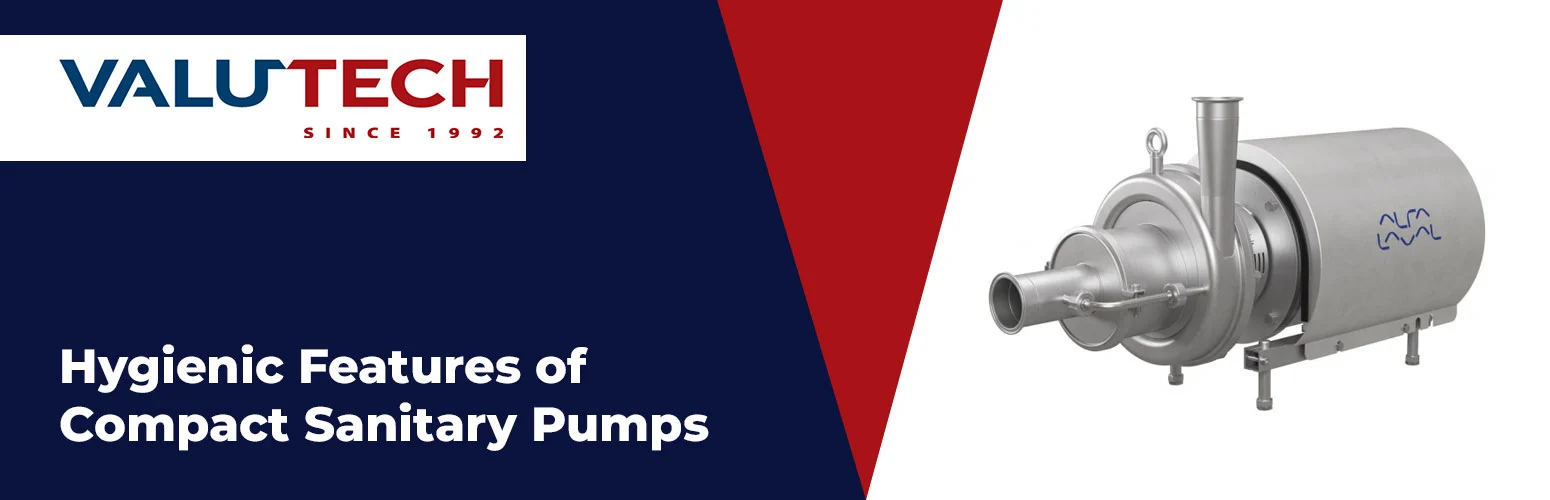
Valutech offers all of Alfa Laval’s sanitary pump ranges for fluid-handling applications in the food, beverage, brewery, biochemical, pharmaceutical, and personal care industries. Our lineup features the following models for low flow rate applications in hygienic industries:
- LKH-5 sanitary centrifugal pump for high-efficiency product transfer and Cleaning-In-Place (CIP) duties requiring relatively high flow rates and moderate pressures.
- SRU1 and SRU2 sanitary positive displacement pumps for gentle, efficient pumping of viscous and shear-sensitive media over a wide pressure range.
- DuraCirc® 32, DuraCirc® 33, and DuraCirc® 34 sanitary circumferential piston pumps for handling media containing solids and/or sensitive particles with a wide performance envelope.
- OptiLobe 22 and OptiLobe 23 sanitary positive displacement pumps for cost-effective hygienic pumping of low to medium-viscosity products in lower-pressure applications.
- OS12, OS14, and OS16 sanitary twin screw pumps for multi-duty hygienic product and CIP pumping applications featuring quiet, low-pulse operation.
This small sanitary pump lineup focuses on centrifugal pumping of low-viscosity fluids up to 100 GPM and positive displacement pumping at displacements of 0.8-4.6 US gallons/100 revolutions, and support the handling of mechanically sensitive fluids with high sanitation requirements. Fundamentally, sanitary pumps are distinguished from their industrial counterparts by stainless steel sanitary pump construction (typically SS316L), polished internal surfaces, designs free from crevices, grooves, and other geometries that lead to dead zones, stagnation, and product buildup. Metallic product-contact surfaces, as well as hygienic seals with flush-mounted, crack-resistant designs are resistant to cleaning-in-place chemicals and elevated temperatures while allowing for complete cleanability and drainability ensuring prevention of product contamination.
Reduced Maintenance Needs and Space-Efficient Designs
Small sanitary pumps such as the models listed above offer efficient designs in compact footprints and have advantages with regards to operational flexibility. Compact models benefit from smaller footprints to assist in streamlining floor space for lean operations and allowing limited production spaces to support commercial production or pilot-scale operations. These effects are compounded when hygienic pumps are integrated in skid-mounted systems as part of modular production lines. Skid-mounted modular systems allow compact sanitary pumps to be matched to individual unit operations, reducing reliance on oversized pumps.
For applications that take place in a series of batches, mobile skids equipped with compact sanitary pumps can be deployed as needed, reducing operating and capital costs associated with purchasing and running oversized pumping equipment, while simplifying maintenance and production. Modular setups also reduce piping complexity, making cleaning and inspection significantly more accessible and efficient. Mobile sanitary pump skids are commonly used in pilot plants and flexible batch processing, where hygienic connections and validated cleaning procedures allow pumps to be used in a series of unit operations; typical applications include:
- Ingredient Transfer
- Product Dosing
- CIP Systems
- Sampling Loops
- Pilot-Scale and Batch Processing
Compact sanitary pumps also simplify routine maintenance with more components that are easier to physically manipulate while providing direct access to seals and wetted parts. These benefits minimize downtime by allowing inspection and routing servicing such as gasket replacement to be completed quicker than with a larger pump.
Future Operational and Design Trends in Hygienic Pumping Applications
Increased demand for sanitary pumps is being driven by growth in the food, beverage, pharmaceutical, biotechnology, and personal care industries. Within existing hygienic industries, increased automation and stricter sanitary regulations will promote the development and utilization of pumps with continually-advancing sanitary features, while wider adoption of CIP and Sterilize-in-Place (SIP) systems in new applications will further expand the use of hygienic stainless steel sanitary pumps.
Equipment specification priorities are shifting from minimizing initial equipment cost to reducing total cost of ownership. As energy consumption accounts for the majority of a pump’s life-cycle cost, manufacturers are increasingly selecting energy-efficient pumps that operate close to their Best Efficiency Point (BEP) for a single duty, or by using multi-duty pumps with variable frequency drives and broad operating windows to streamline operations. Other design improvements such as improved hydraulic performance, quieter operation with less vibrations, and features for simplified maintenance further reduce operating costs while maintaining hygienic product quality.
Multi-duty hygienic pumps present another significant design trend; modern designs such as Alfa Laval’s LKH Prime self-priming and OS Twin Screw pump are capable of performing both product transfer and CIP duties, reducing the need for dedicated pumping equipment and therefore lowering both purchasing and operating costs. Together with compact modular skids and other optimizations in plant design such as valve automation, small sanitary pumps will continue to support more flexible production layouts with lower lifetime costs.
The first step effective, long-term operation of small sanitary pumps is selecting the right partner with the expertise and product base to provide the optimal solution. Partnership with Valutech ensures access to a strong supply chain and a wealth of maintenance and operational experience for virtually any hygienic pumping application. This article is a brief introduction to hygienic pumps — for more information on available sanitary twin screw pump and other stainless steel sanitary pump models, their features, and recommended maintenance practices, please contact Valutech here, or see the full sanitary pump lineup here.