
Proper selection of appropriate pool heat exchanger models and maintenance to ensure a long operating life are two key factors in reducing pool heat exchanger costs over the lifetime of the unit. Pool heat exchanger applications include: residential and commercial swimming pools, hot tubs, spas, therapy pools, wave pools and lazy rivers, fountains, infinity pools, cold plunge pools, reflecting pools, and fish ponds, among many others. Each application has unique design factors, and by understanding the application, including average flow rates, operating schedule, water composition, and temperature, one can select an appropriate model and implement a maintenance plan.
This article provides a brief overview of the primary design and operational issues that affect pool heat exchanger operation, how to diagnose and address maintenance needs, and best practices to increase operational uptime and reduce reactive maintenance.
Deterioration of heat exchanger wear components or buildup of contaminants reduces the ability of the unit to perform up to its design specifications, leading to improper conditions in your pool and/or increased operating costs. These Reductions in heat transfer ability contribute to improper heating and cooling per design specifications, meaning that one must supply more energy at increased operational cost to make up for the deficit, or risk customer dissatisfaction. The primary degradation mechanisms of pool heat exchangers include:
Factors in Pool Heat Exchanger Reduced Performance
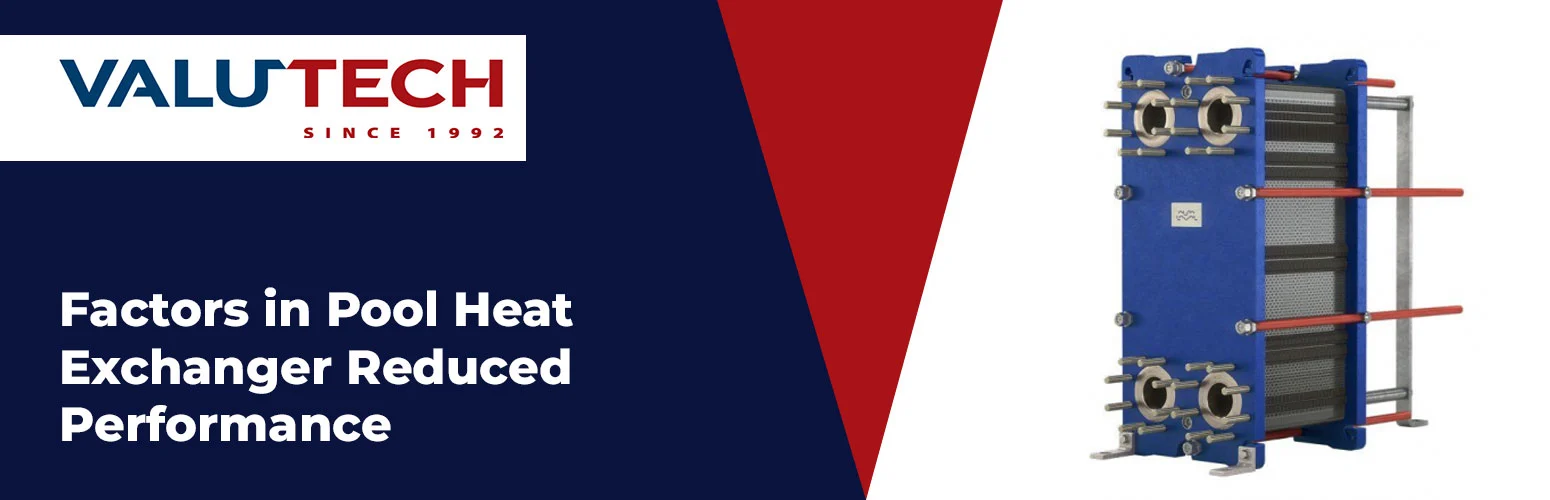
Deterioration of heat exchanger wear components or buildup of contaminants reduces the ability of the unit to perform up to its design specifications, leading to improper conditions in your pool and/or increased operating costs. These Reductions in heat transfer ability contribute to improper heating and cooling per design specifications, meaning that one must supply more energy at increased operational cost to make up for the deficit, or risk customer dissatisfaction. The primary degradation mechanisms of pool heat exchangers include:
Scaling
The presence of dissolved minerals (hard water) in pool water leads to scaling — the formation of mineral layers on water-contacting surfaces. This occurs as dissolved minerals, such as calcium, come out of solution in mineral-containing water to precipitate (crystalize) as solid deposits. While incoming cold water contains dissolved minerals at stable levels, higher temperatures in heat exchangers force precipitation; these layers insulate heat transfer surfaces to reduce thermal efficiency.
Macroscopic Debris
Large contaminants such as dirt, leaves, and hair are capable of bypassing filtration systems and accumulating inside the heat exchanger to restrict flow, increasing pressure drops and reducing heat transfer efficiency.
Biofilm Formation
Biofilms are layers of organic matter (e.g. bacteria and algae) that are highly resistant to cleaning chemicals as compared to organic matter not part of a film. These layers restrict flow paths and insulate heat transfer surfaces to reduce efficiency.
Improper Water Chemistry and Material Compatibility
Imbalanced pH levels and high levels of chlorides (charged particles formed from salt, chorine, and other disinfectants) corrode incompatible materials, such as stainless steel. Chemical degradation causes pitting and wear, leading to leaks and eventual failure. Where there are elevated chemical-based concerns in a pool, it is advisable to select a more corrosion-resistant material for heat exchanger heat transfer parts, such as titanium.
Flow-Related Issues
Low flow rates promote stagnation inside heat exchangers leading to fouling, while excessive flow can cause erosion/abrasion of internal surfaces and premature wear. It is also important to factor in the overall load of a pool heat exchanger — the higher the operating temperatures and the longer the uptime, the quicker wear parts will deteriorate.
Diagnosing and Addressing Maintenance Needs
Diagnosis of a pool heat exchanger system starts before disassembly; operators can verify inlet/outlet temperatures, temperature approaches, pressure sensors and gauges, as well as check for leaks, external damage/corrosion, and water discoloration. An abnormality in the above checks is an indicator that fouling, scaling, debris/biofilm buildup, and/or equipment damage has occurred. Ensure that auxiliary pumps, filters, and piping do not have issues to prevent unnecessary heat exchanger down time or premature parts/unit replacement.
Cleaning can be performed manually with brushes and high-pressure water to remove debris and macroscopic fouling, as well as some scale. Chemical cleaning can also be performed to dissolve scale, biofilm buildup, and other hard chemical deposits. The methods available to an operator are limited by the physical design of the heat exchanger — bonded heat exchangers can only be cleaned chemically for example, while gasketed plate-and-frame or shell and tube units can be taken apart and cleaned manually or with chemicals.
When heat exchanger internals are inspected, degraded gaskets should be replaced, and leaking or visually damaged and corroded components must be replaced or repaired. With standard heat exchanger models, parts such as plates and tube stacks can be replaced quickly and independently to prevent the need to order a completely new unit.
Preventative Maintenance and Operational Best Practices
Simply by maintaining optimal water chemistry, including proper pH, softening of water/inhibitors of scale, as well as proper filtration, and use of primary (chlorine, etc.) and secondary (non-oxidizing biocides and/or shock treatments) antibacterial treatments, one can significantly reduce the routine issues described above.
Where possible, temperature, pressure, and flow sensors and alarms assist in tracking issues and addressing them before they can cause damage to the system. Operating within design parameters and performing preventative maintenance of parts beginning to wear or cleaning of areas that are beginning to foul will extend the lifetime of a pool heat exchanger. Also, consider seasonal factors — for example, in cold climates freeze protection and proper system drainage are critical to prevent damage to the system, and avoiding thermal shock by gradually attaining the target temperature upon startup is recommended.
The first step in maintaining your pool heat exchanger for long-term operation is selecting the right partner with the expertise and product base to provide the optimal solution. Partnership with Valutech ensures access to a strong supply chain and a wealth of experience for all pool heating applications.
This article is a brief introduction to pool heat exchanger repair — for more information on available pool heat exchanger models, their features, and recommended maintenance practices, please contact Valutech here, or see the full pool heat exchanger lineup here.