
Steam-to-liquid heat exchangers are widely used in production industries as the properties of steam make it an ideal solution for efficient, consistent, and high-capacity heat transfer. Steam heat exchangers capture the latent heat of condensation, transferring the heat to the target fluid at a nearly constant temperature with a relatively small heat transfer surface area, therefore supporting more compact heat exchanger designs. Steam is operationally simple to generate using boilers and distribute throughout a production facility or building to support space heating and domestic hot water applications using shell and tube steam to water heat exchangers. Industrial process applications also commonly rely on steam heat exchangers; liquids would otherwise require a larger mass to achieve the same heat capacity and therefore be more expensive to supply. This article provides a brief overview of the principles of steam heat transfer, the benefit of using shell and tube heat exchangers for steam-to-liquid heating, and recommended operational practices to extend product lifespan and operate efficient systems.
Heat Transfer in Steam-to-Liquid Shell and Tube Heat Exchangers
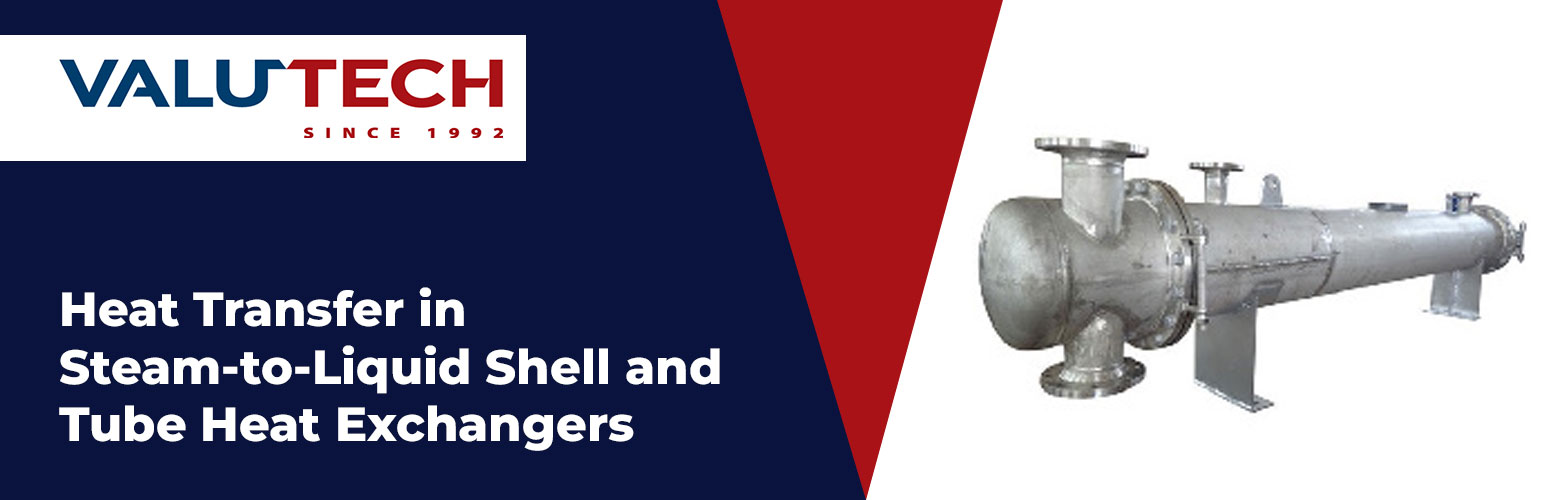
In a shell and tube steam-to-liquid heat exchanger, heat transfer is driven by the latent heat of condensation — the heat expelled by steam as it condenses into water. This is in contrast to sensible temperature change, which is what occurs in liquid-to-liquid heat exchanger designs. In shell and tube designs, steam is usually supplied on the shell side in order to promote uniform steam distribution with gravity-based condensate drainage, and to keep pressure drops low with a larger flow area. Steam enters the heat exchanger shell at saturation or superheated temperature, condensing on the cooler tubes carrying the process fluid. This condensation releases heat that conducts through the tube walls to heat the process fluid, while the steam condensate is removed with a steam trap assisted by gravity. Baffles inside the shell are used to direct steam flow across the tube bundle to promote contact along the surface and assist in controlling condensate drainage. The condensate film on the outside of the tubes and fouling inside the tubes are limiting factors in heat transfer as these provide thermal insulation; designs that mitigate these factors are crucial for effective heat transfer.
Suitability of Shell and Tube Design for Steam Applications
As compared with other heat exchanger designs, such as gasketed plate and frame or brazed plate heat exchangers, shell and tube steam heat exchangers are well-suited for steam-to-liquid services:
- Shell and tube heat exchangers have larger flow passages, reducing the mitigating effects of fouling on heat transfer efficiency.
- They also have thick-walled tubes and shells that can withstand higher pressures relative to thin plates in plate heat exchangers.
- Features such as floating heads and U-tubes accommodate high temperature expansion without deterioration.
Although steam is often allocated to the shell side, there are many specialized design scenarios where it is better to allocate it to the tube side. For example, viscous fluids are more costly to pump through tubes where the pressure drop is higher, and they also benefit from increased turbulence via baffles on the shell side to promote better heat transfer. Issues with tube side steam allocation are mitigated by maintaining proper tube slope for condensate drainage, limiting steam velocity, and effectively trapping/venting steam at tube outlets.
Best Operational Practices to Maximize Efficiency, Safety, and Service Life
A core consideration of shell and tube steam heat exchangers is the constant generation of condensate, which must be removed from the system under continuous operation. The flow rates and temperatures of condensate downstream of the heat exchanger provide an indicator of whether or not the system is properly removing condensate. Condensate flooding may be caused by blockages in piping and valves from precipitates or freezing, backpressure, and poor installation or system design. Checking for insufficient removal prevents flooding and reduced heat transfer capabilities caused by pooled condensate insulating the system.
Flooding and fouling will also lead to high pressure drops, performance loss, and water hammer causing system damage and reduced efficiency. Mechanical cleaning of the shell and tubes can be performed with brushes or high-pressure water, and chemical cleaning uses formulations specifically-designed for the target fluids. As tubes are easier to clean mechanically compared to shells, especially when they are straight and/or part of a removable tube bundle, fouling liquids tend to be circulated through the them. Compared to replacing the entire shell assembly, the tubes are also more economical to replace in the event of corrosion or fouling beyond the point of being cleanable.
During standard operation, it is crucial to practice controlled startup and shutdown — this refers to slowly introducing fluid flow to allow uniform and gradual temperature changes in heat exchanger components. Rapid temperature changes and thermal shocks lead to deterioration of tubes, gaskets, and joints; this causes the system to leak, and eventually results in total failure. Proper venting must also be done to ensure even steam distribution and reduce the risk of thermal stress and water hammer. During startup, air and other non-condensable gases should be vented from high points on the shell; trapped air prevents steam from evenly contacting the heat transfer surfaces.
The first step in selecting the right steam heat exchangers for your steam-to-liquid application is selecting the right supplier with the expertise and product base to provide the optimal solution. Partnership with Valutech ensures access to a strong supply chain and a product lineup to suit the needs of virtually any application. This article is a brief introduction to shell and tube steam heat exchangers — for more information on available models, their features, and recommended maintenance practices, please contact Valutech here, or see the full steam heater lineup here.