
Heat exchangers are used In a variety of applications to transfer heat from a heat source to water in residential or commercial pools, spas, or hot tubs. Pool temperatures are maintained at the desired level by running a heating loop through the heat exchanger using services fluids heated by boilers, heat pumps, or renewable heat sources such as solar-heated or geothermal water. Stainless steel is often nominated as the heat transfer material of choice for pool heat exchangers due to its durability, affordability, availability, and corrosion resistance. Pool heat exchanger varieties include shell and tube, plate and frame, and fusion bonded, among others. This article provides a brief overview of the stainless steel pool heat exchangers varieties that Valutech offers, including their design principles, optimal applications, and other considerations for their specification and purchase.
Stainless Steel Shell and Tube Pool Heat Exchangers
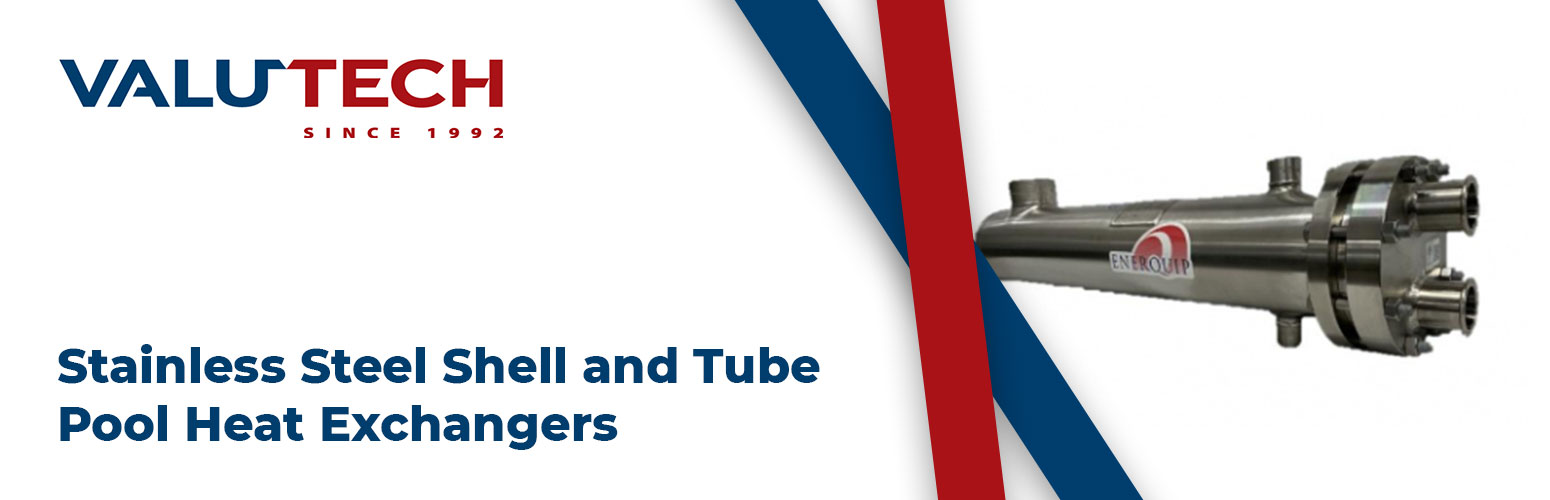
Shell and tube heat exchangers have a series of parallel tubes, known as a tube bundle, within a shell; the tubes and shell each contain different fluids that transfer heat across the width of the tubes. Due to having larger diameter flow paths, they are better able to handle debris and suspended solids without clogging. Large flow paths also allow for higher flow velocities without the risk of erosion or spikes in pressure due to pump surges. The tubes expand axially due to swings in temperature, which are relatively common in pool heat sources such as boilers and solar-powered heaters. The thickness of the tube bundles and a geometry that keeps the flow path fully flooded also makes shell and tube units more resistant to corrosion. Shell and tube units require a larger surface area compared to the plate-style units for a similar heat transfer requirement necessitating higher approach temperatures.
Valutech supplies CN-Series shell and tube heat exchangers designed and built by EJ Bowman in England. These units feature removable tube bundles for simple mechanical maintenance and are compatible with condensing boiler and heat pump systems, as well as solar and geothermal heat sources. These models are available with stainless steel tubes, among other materials, and come in 12 sizes to suit pools ranging in volume from 8,000-300,000 gallons.
Stainless Steel Gasketed Plate and Frame Pool Heat Exchangers
Gasketed plate and frame heat exchangers use a series of parallel plates, known as a plate pack, with alternating flow channels to exchange heat between two fluids across the width of the plates. These plates often have grooves and ridges in their geometry to promote turbulent flow and even flow distribution across the plate surface to improve heat transfer efficiency. They are more thermally efficient per unit volume relative to shell and tube models due to their thin plates and high heat transfer surface area. This efficiency allows for tighter approach temperatures, meaning that less energy input is required to achieve heating equivalent to a shell and tube unit. In turn, this means pools can be heated relatively faster with input energy levels approaching those that would be used for shell and tube units. Gasketed units are capable of being opened, and each plate can be removed individually for mechanical cleaning. However, the polymeric composition of the gaskets (which seal the gaps between flow channels in the “ports” of the plates) limits the maximum chloride content and temperature the heat exchanger can handle. Narrow channels in the plate gaps are more prone to clogging in cases of poor filtration, but plates are easier to clean than tubes and can be replaced individually in case of issues.
Valutech offers Alfa Laval’s M-Series and T-Series models of gasketed plate and frame heat exchangers for pool heating applications. These units feature advanced designs, such as specially-designed plate patterns, to optimize heat transfer efficiency and are capable of being operated with extremely close (2°F) temperature approaches. Due to their ability to quickly heat up pools, they have quick turn-around times in pool fouling events. They are also suited for larger pools in commercial and public settings with their ability to be serviced and cleaned to levels in compliance with municipal sanitation regulations without disturbing piping.
Stainless Steel Fusion Bonded Pool Heat Exchangers
Fusion bonded plate heat exchangers have similar designs to gasketed plate and frame style units in that they use a plate pack with alternating channels to transfer heat. The key difference is that the plates are permanently bonded with a filler metal — this means that the construction is completely stainless steel and gasket-free, eliminating concerns with chloride concentration and degradation due to high temperatures. They are also highly thermally efficient relative to unit volume, and are even more compact than gasketed plate and frame units to further promote high efficiency and quick pool heating times. Fusion bonded pool heat exchangers are considered maintenance-free in both the positive and negative sense — they cannot be opened to be maintained, so chemical cleaning is the only option. They are often replaced more quickly as maintenance costs begin to increase, which is made feasible by their relatively low cost of acquisition. As a plate-style heat exchanger, it is more sensitive to thermal shock and pressure spikes and has a lower allowable flow velocity relative to the equivalently-sized shell and tube heat exchanger model.
Valutech provides Alfa Laval’s AlfaNova fusion bonded plate heat exchanger for highly-chlorinated pool systems. The AlfaNova is the only 100% stainless steel plate heat exchanger model on the market, and is typically used in the following pool applications:
- Pool Make-Up Water Heat Recovery Systems
- Low Temperature Condensing Boiler Systems
- Geothermal Heating
It is common to install a dehumidifier to remove excess moisture and cool the air in indoor pool settings — the AlfaNova is chemically compatible with the chlorinated pool water. It can be then used as a dedicated heat exchanger to capture the latent heat released during condensation and reuse that energy for pool water heating, reducing the energy load of the main heat source (boiler, etc.).
The first step in selecting the right heat exchangers for your pool or spa is selecting the right supplier with the expertise and product base to provide the optimal solution. Partnership with Valutech ensures access to a strong supply chain and a product lineup to suit the needs of virtually any application. This article is a brief introduction to stainless pool heat exchangers — for more information on available models, their features, and recommended maintenance practices, please contact Valutech here, or see the full pool heat exchanger lineup here.